100% Green Growing minimises the use of chemical crop protection products
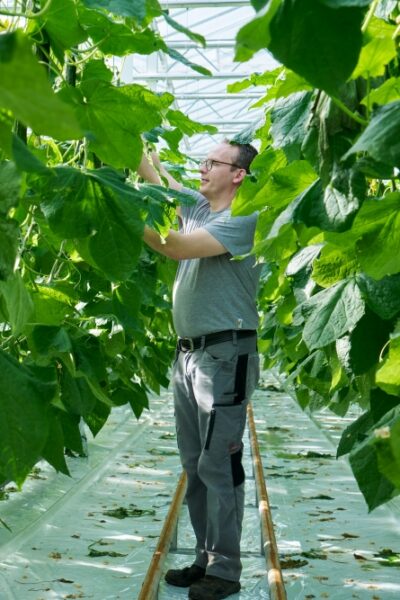
Fitterstee Growers, based in Ooltgensplaat, is exploring how to grow cucumbers with as few synthetic crop protection products as possible. In the second year of the 100% Groen Geteeld field pilot, the family business reduced its use of chemical active substances by 87% compared with its previous practices. The Greenery supports Fitterstee throughout the process, connecting the grower with expertise and partners within the programme.
Preparing to grow with fewer chemicals
The availability of chemical crop protection products is declining rapidly, while climate change continues to bring new diseases and pests. Growers need to keep these under control, maintain quality and remain profitable. At the same time, society expects growers to adopt increasingly sustainable practices. For Fitterstee, this is a reason to gain experience with a different approach to cultivation now.
The family business is therefore taking part in 100% Groen Geteeld, an initiative of the Federation of Fruiting Vegetable Organisations (FVO). In this multi-year field pilot, seven greenhouse vegetable businesses are working with grower organisations, suppliers, researchers and technology specialists to develop an integrated, resilient growing system for aubergines, cucumbers, sweet peppers and tomatoes. The focus extends beyond crop protection to include climate, water, nutrition, growing media and plant resilience. The Greenery is one of FVO’s member organisations and nominated Fitterstee as the pilot business for cucumber cultivation without supplementary lighting.
Kristian van der Wel, Quality, Safety & Environment Manager at The Greenery, supports Fitterstee throughout the process. He monitors developments at the business and helps translate insights from the programme into day-to-day growing practices.
Not replacing one product, but changing the growing system
Within a one-hectare section of Fitterstee’s newest greenhouse, the team is exploring a growing system in which chemical interventions are needed less frequently and used only as a last resort. Biological control agents, such as predatory mites and parasitic wasps, form the foundation, supplemented by greener crop protection products. Other measures include plant activators, adjusted fertilisation, attention to root health and growing media, more precise climate measurements and technical measures such as fitting insect netting to greenhouse vents.
The strength lies in combining measures and expertise. Partners in the programme include Koppert, Van Iperen, Van der Knaap and various research and technology organisations. Experiences are shared between the pilot businesses, so each company does not have to go through the same learning process independently.
Kristian van der Wel: “The strength of this pilot is that we look not at a single product, but at the entire growing system. Together with Fitterstee and the other partners, we are exploring in practice what works, where the limits lie and what is needed to make cultivation greener without losing sight of quality and profitability.”
87% fewer chemical active substances
After two years of the pilot, the results are clear. In the second year, Fitterstee used 87% fewer chemical active substances than under its previous practices. This puts the company well ahead of the average reduction of 64% across the seven pilot businesses that year. The biological approach is proving particularly effective in insect control. Adriaan van Gurp of Fitterstee: “We are achieving good results in controlling insects with biological methods, but we still have progress to make before fungal diseases can be managed using entirely green methods.”
This remains the main challenge. Fungal diseases such as Mycosphaerella and powdery mildew cannot yet be controlled under all conditions without chemical intervention. The transition is not yet fully economically viable either. Natural enemies and greener crop protection products are often more expensive than conventional alternatives. Across the project, crop protection costs in the second year were still €1.29 per square metre higher than before the project began, although they were already €0.30 lower than in the first pilot year.
Van Gurp sums up the trade-off pragmatically: “The challenge is to strike a balance between growing more sustainably with less chemical crop protection and remaining profitable.”
From the pilot greenhouse to the rest of the business
The benefits of the pilot extend beyond the one-hectare trial area. Fitterstee is now applying the knowledge gained in its other greenhouses. For example, the greener crop protection product Azatin is also being used there, eliminating the need for chemical intervention against caterpillars, among other pests.
This demonstrates what collective development can offer an individual grower. Through FVO and The Greenery, Fitterstee gains access to practical research, specialist expertise and other growers tackling the same challenge. Fitterstee then tests that knowledge under commercial growing conditions and feeds its own experiences back into the programme.
The goal of 100% green cultivation has not yet been achieved. However, the 87% reduction shows that major progress is possible when growers, the cooperative, knowledge partners and suppliers work together on the growing system.
For Van Gurp, the direction is clear: “Absolutely, I’m not letting this go. Because the future is green.”
Andere projecten
Precision down to the individual tree
Sustainable strawberry cultivation: Kwekerij Loos is ready for the future
On shelves earlier, grown more efficiently: the rise of Inspire
Sweet Sensation pears: a sustained price premium through control over cultivation, quality and the market