Precision down to the individual tree
Technology helps Slabbekoorn Fruit grow more sustainably and efficiently.
How do you give each tree exactly what it needs? At Slabbekoorn Fruit in Kapelle, Zeeland, data and technology are playing an increasingly important role. The family business combines generations of growing expertise with drones, soil scanners, sensors, GPS and ever-greater automation. This makes apple and pear cultivation increasingly precise and allows resources to be used in a more targeted way.
Six generations of fruit growing
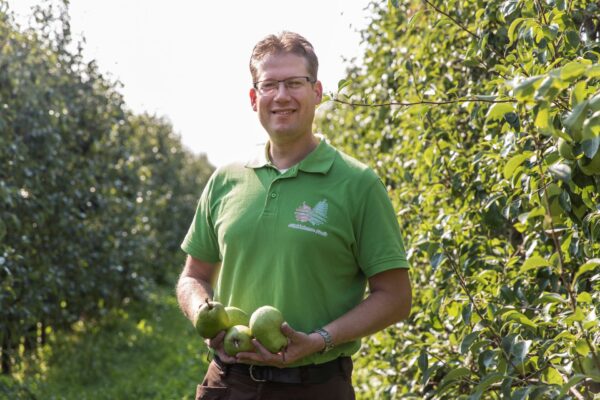
Slabbekoorn Fruit is run by Martijn and Jessica Slabbekoorn. The family business dates back to the late nineteenth century, with the sixth generation now at the helm. The business covers approximately 70 hectares, including around 5 hectares of arable land. Varieties including Conference, Doyenné du Comice and Elstar are grown at several sites across Zeeland.
That long history does not mean the company sticks to old ways of working. On the contrary, Slabbekoorn continually explores how new technologies can make cultivation more precise, efficient and sustainable.
Drones as an extra pair of eyes above the orchard
The use of drones is a good example. Slabbekoorn flies drones over its orchards, using remote sensing to map differences in flowering and growth. RTK-GPS allows the precise location of the measurements to be recorded. The drone imagery is then processed into data and prescription maps that can guide machinery in the orchard.
This reveals which trees are flowering heavily and which are lagging behind. Rather than treating an entire plot uniformly, the grower can take a much more targeted approach. Areas with heavy blossom, for example, can be treated differently from areas where growth is weaker.
Every location has different needs
The same principle applies to the soil. Soil scans reveal differences within individual plots. These insights allow a more targeted approach to drainage, irrigation and fertilisation, among other things. The aim is not to apply the same amount everywhere by default, but to tailor treatment to the needs of each location.
This brings precision fruit growing ever closer to treatment at individual tree level. As Martijn Slabbekoorn described it, the company uses techniques such as soil scans, drone flights and computer programs to try to give every tree what it needs.
Crop protection only where needed
Technology also enables greater precision in crop protection. The orchard sprayers use GPS, prescription maps and sensor technology. Sensors detect where foliage is present, allowing the output of each spray nozzle to be adjusted. Where there are gaps between trees or branches with no foliage, there is no need to apply crop protection products.
Slabbekoorn also uses three weather stations. The collected data is linked to computer models that help predict disease development, making it easier to determine when intervention is genuinely needed. Wherever possible, natural enemies are also used to control diseases and pests.
The result is a growing strategy in which more and more decisions are informed by up-to-date information from the orchard.
Data from orchard to storage
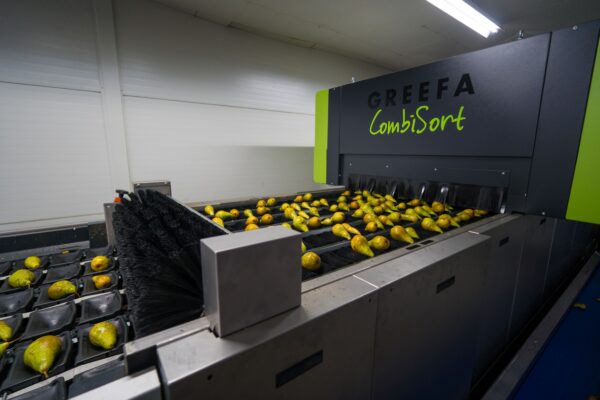
At Slabbekoorn, digitalisation does not stop once the fruit has been picked. The company is also developing record-keeping throughout the supply chain. Storage bins have unique barcodes and can be tracked during harvesting, transport, cooling and further processing. Earlier trials also used GPS to record the position of bins in the orchard. This provides growing insight into where the fruit comes from and the route it takes after harvest.
Technology is also used to support employees. With Pluk-o-Track machines, Slabbekoorn aims to assist harvesting work and improve working conditions.
The next step: further robotics
Development continues. Slabbekoorn is actively exploring further robotisation of orchard tasks. Looking ahead, the company also sees opportunities to extend the use of robotics to apple and pear harvesting.
Slabbekoorn Fruit shows what modern fruit growing can look like: expertise remains the foundation, while data gives the grower more information to make the right decision at the right time. Rather than treating every plot in the same way, the focus is increasingly on what the soil, tree and fruit actually need. This brings together greater efficiency, product quality and a lower environmental impact.
Deze link gaat naar een externe website.Andere projecten
Sustainable strawberry cultivation: Kwekerij Loos is ready for the future
100% Green Growing minimises the use of chemical crop protection products
On shelves earlier, grown more efficiently: the rise of Inspire
Sweet Sensation pears: a sustained price premium through control over cultivation, quality and the market